Smart Baby Bottle Temperature Control: Three Routes for 2026
"Is the water the right temperature?" is the question that wakes parents at three in the morning. It has turned into one of the most commercially interesting corners of the baby feeding market — and not every route to answering it is equally hard to build.
1. Why temperature control commands a premium
Modern formula often carries heat-sensitive ingredients — probiotics, lactoferrin. Water above roughly 45–50 °C deactivates them; water too cool leaves the powder clumping and the baby unsettled. The traditional test, a drop on the wrist, depends entirely on the parent's judgement.
At night the problem compounds. Finding hot water, tempering it, testing it — all in low light, with a crying baby — is exactly the kind of friction parents will pay to remove. That willingness is what gives temperature-control products their margin.
2. Three routes, in ascending order of difficulty
Route 1 — Temperature-sensing markings or silicone (passive)
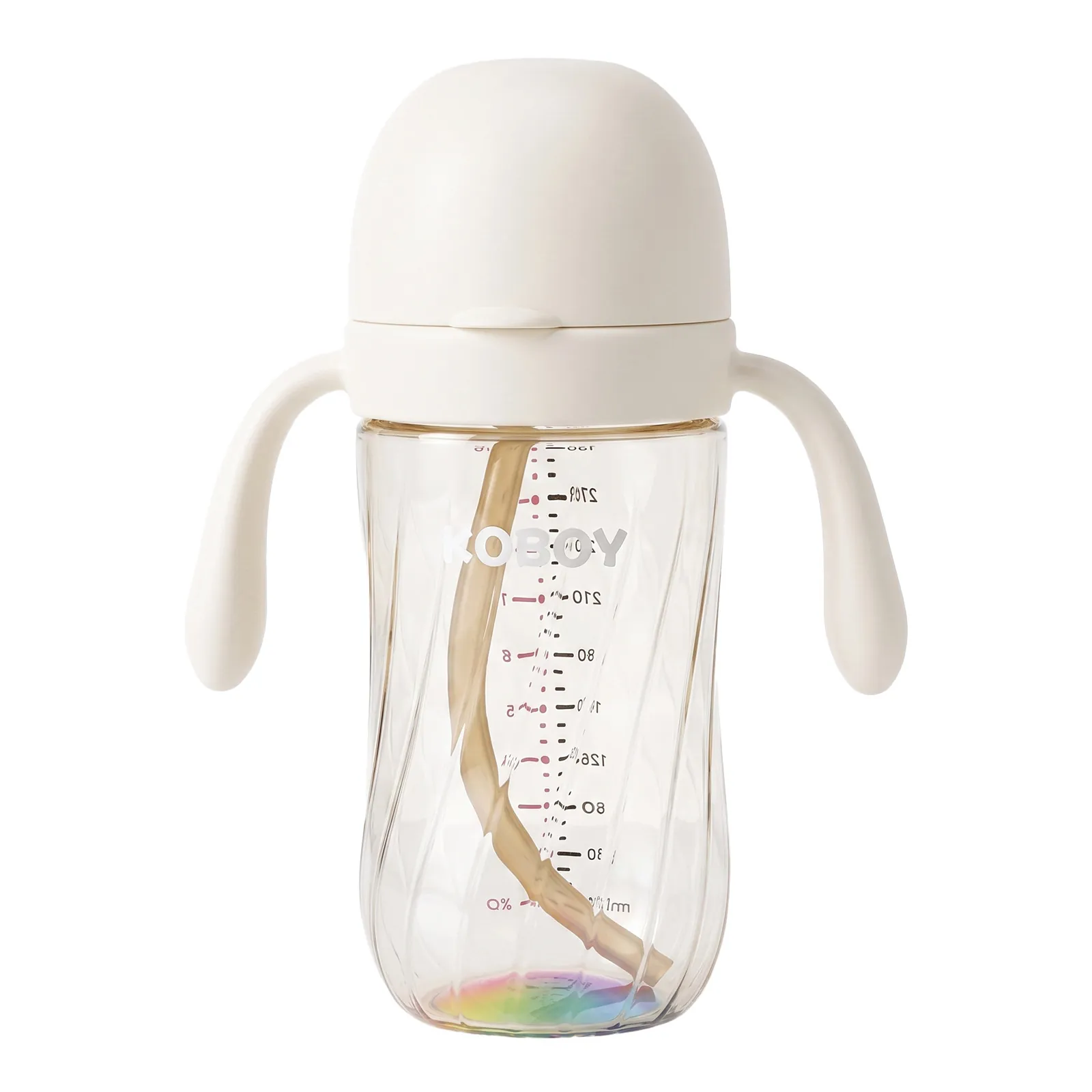
Heat-sensitive pigment is applied to the bottle body or a silicone element. Above a set threshold the marking changes colour. On the bottles KOBOY produces, the temperature-sensing graduation line changes above 45 °C.
This is the route with the lowest barrier. There are no electronics, no battery, no waterproofing question and no new safety certification category. The tooling change is minor and the bill-of-materials impact is small — which is why it is the most sensible first move for a brand that wants a temperature story without a hardware programme.
The limit is precision. It tells a parent "too hot" or "not too hot". It does not report a number.
Route 2 — Digital readout (active)
An NTC thermistor and a small chip sit in the base or a sleeve, driving an LED or OLED display. Some versions add an audible or visual alarm above a set temperature.
The difficulty is not the sensor. It is everything around it: IPX7 sealing, food-safe separation between the electronics and the liquid, and battery safety and transport certification. This is a different manufacturing discipline from injection moulding, and it is usually why a project stalls.
Route 3 — Heated base (system)
A detachable base with a battery and a flexible heating film holds the contents at a target temperature, typically around 42 °C, for hours. It answers the night-feed and travel problems at once.
Commercially this is the strongest position: it is not a bottle, it is a platform, and it carries gift pricing. It is also the hardest to ship — the electronics, thermal control, battery certification and after-sales support all become your problem.
3. What each route costs you to build
| Route | Tooling change | New supply chain | Certification load |
|---|---|---|---|
| Passive sensing | Minor (marking / silicone insert) | None | Existing food-contact testing only |
| Digital readout | Moderate (base or sleeve) | PCBA, sensor, battery | Electronics safety, IPX7, transport |
| Heated base | High (new platform) | PCBA, battery, heating film | Full electronics + battery regime |
4. Where KOBOY's own production ends
This is worth stating plainly, because the industry is full of suppliers who will claim all three routes.
What we make. The bottle body in PPSU or PP; the silicone components; and the temperature-sensing markings and inserts — the passive route — on our own tooling, in our own workshops. Our temperature-sensing training cup is an example of that in production.
What we do not make. Electronic modules: sensors, circuit boards, batteries and heated bases sit outside our own production — as do the borosilicate glass bodies, which come from a partner glassworks rather than our own lines. We are a moulding and assembly factory, not an electronics manufacturer, and we would rather tell you that at the start than discover it matters halfway through a project.
If your product needs Route 2 or Route 3, we can manufacture the bottle and silicone elements that the electronics integrate into, and we will tell you honestly that the electronic side needs a partner we do not currently have.
5. If you are planning a temperature product
- Start with the route, not the product. Decide whether you are selling a bottle with an indicator or a feeding appliance. The manufacturing consequences are entirely different.
- Check the threshold number. "Changes colour when warm" is not a specification. 45 °C is; make sure the number you advertise is the number the pigment is set to.
- Ask what happens after sterilisation. Heat-sensitive markings live in a hard environment. Ask how many steam cycles the marking survives before it stops changing colour.
- Budget the certification before the tooling. Electronics certification is a schedule item, not a formality.
If your programme is on the passive route, send us the threshold you need and the bottle body you have in mind — see how we run a development project or send us the brief.